

Configuration Guide for External Service Incident Dynatrace on the Elven Platform
The External Services Center of Elven Platform is the bridge that connects you to the best tools on the market to monitor, manage, and resolve incidents in a simple and efficient way. In it, you can integrate Dynatrace with Elven Platform, allowing the reception of notifications and events related to incidents directly on the platform. This enables you to monitor and analyze your applications and services from the perspective of Incident Management, using the best practices and methodologies in the market, all in one place.
API Token
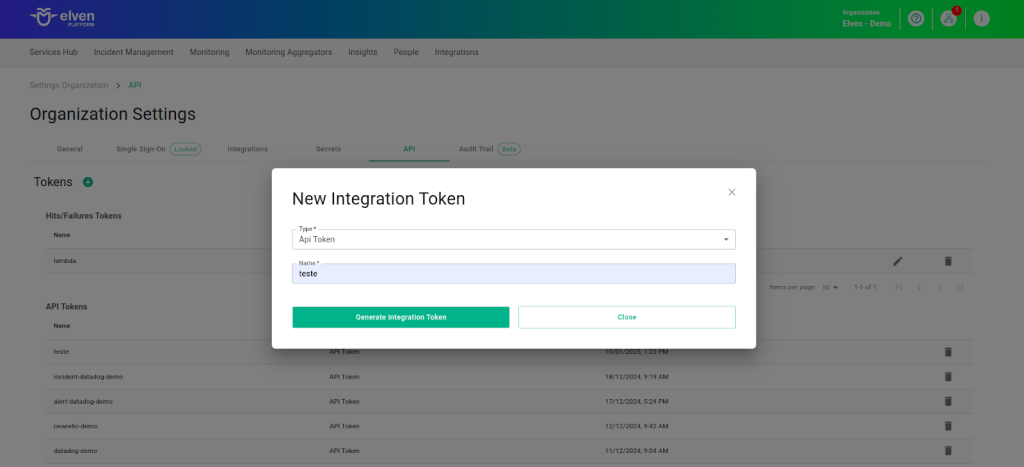
To integrate Elven Platform with Dynatrace, we need to create an API Token. This unique key is essential for the two platforms to connect securely, ensuring reliable and authenticated information exchange. Simply access the Organization Settings of Elven Platform, navigate to the API section, and generate.
Creating an API Token
In the top menu, under your user settings, click on Organization Settings.
In the API tab, click the + button to create a new API Token.
Accessing External Service Incident Dynatrace
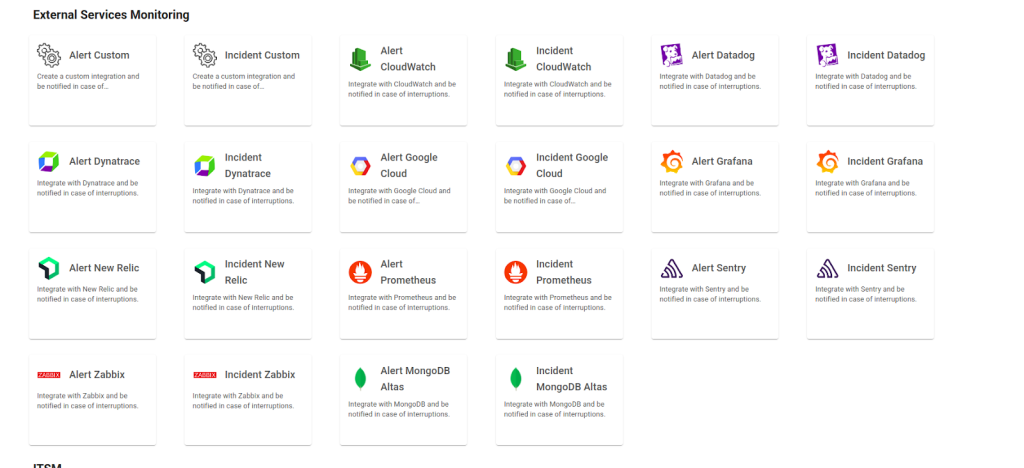
Navigate to the main menu and click on Services Hub.
In External Services Monitoring, select the Incident Dynatrace item.
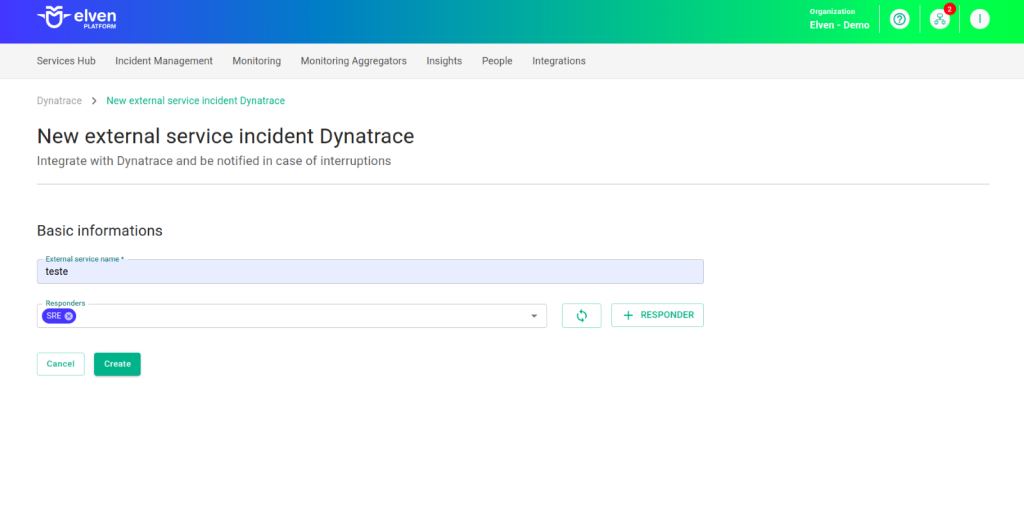
Creating the External Services Incident Dynatrace
In the form, start by filling in the External Service Name field, which will be the name of the external service, and define the Responders, that is, the people or teams who will receive notifications related to this service. After that, click CREATE to proceed. This action will create the initial record of your external service.
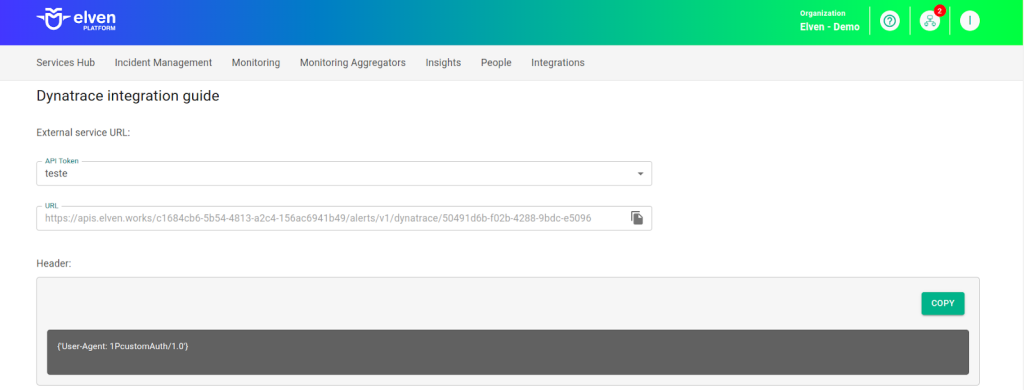
Then, locate the API Token you generated earlier and select it to configure the integration with Dynatrace.
Configuring Webhooks in Dynatrace
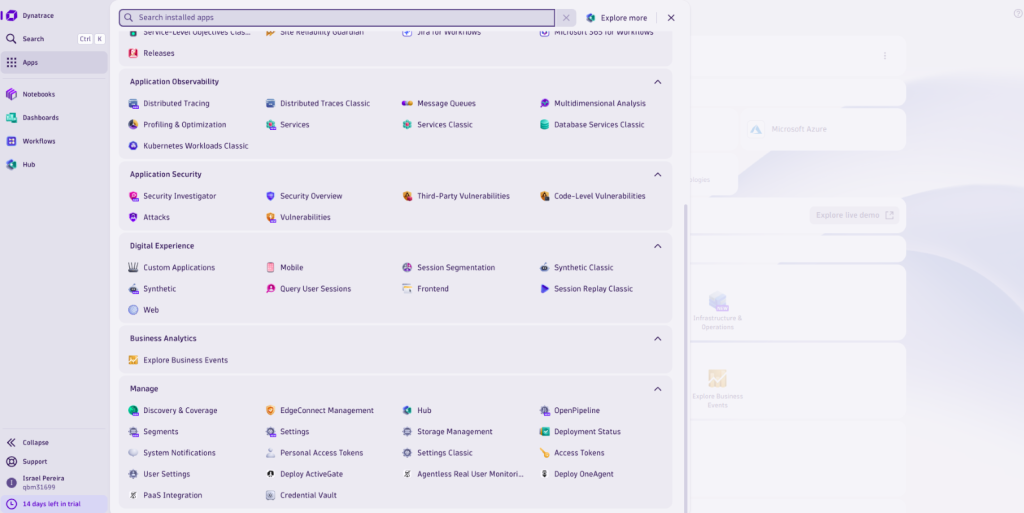
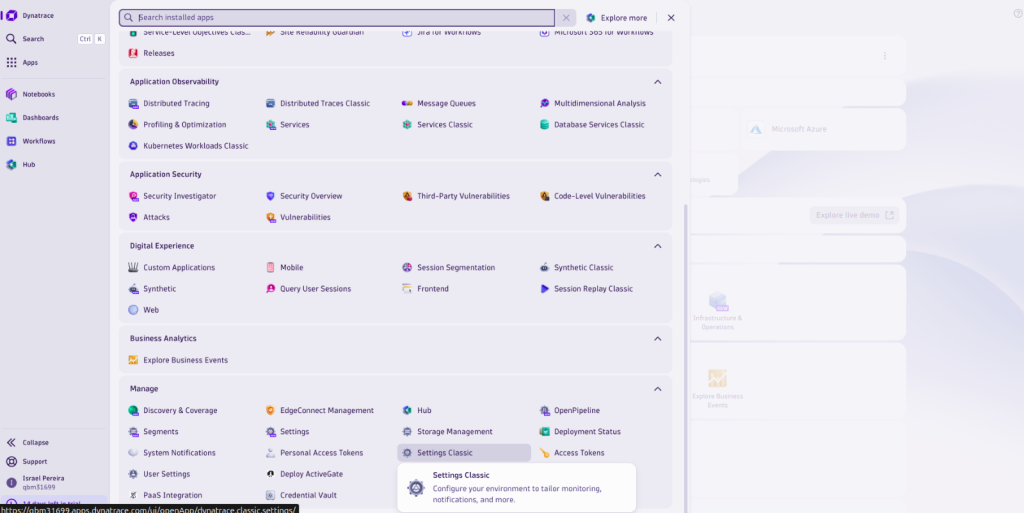
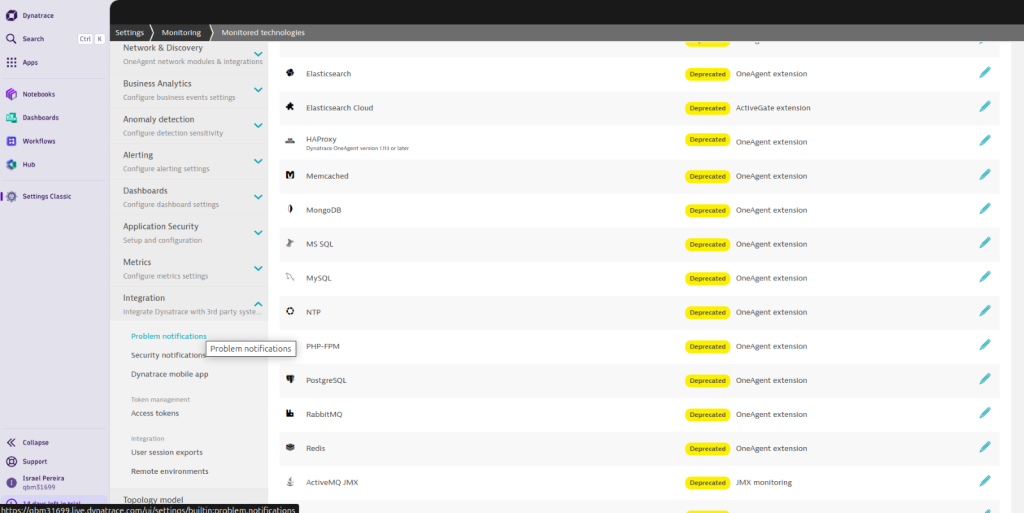
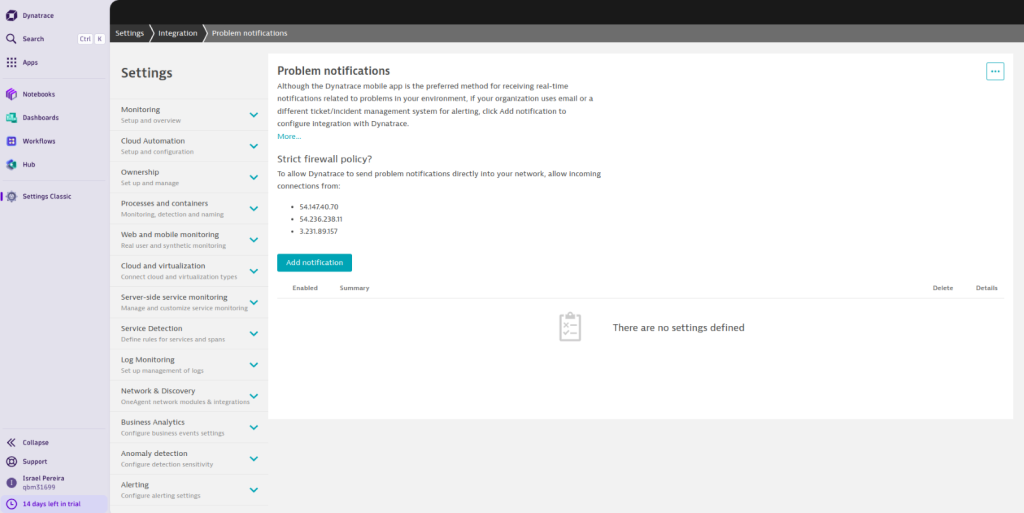
To configure a webhook in Dynatrace and integrate it with the Elven Platform, the process is simple and straightforward. Start by accessing the left side panel in Dynatrace, navigating to Apps > Manage > Settings Classic. There, go to the Integration section and choose the Problem Notification option.
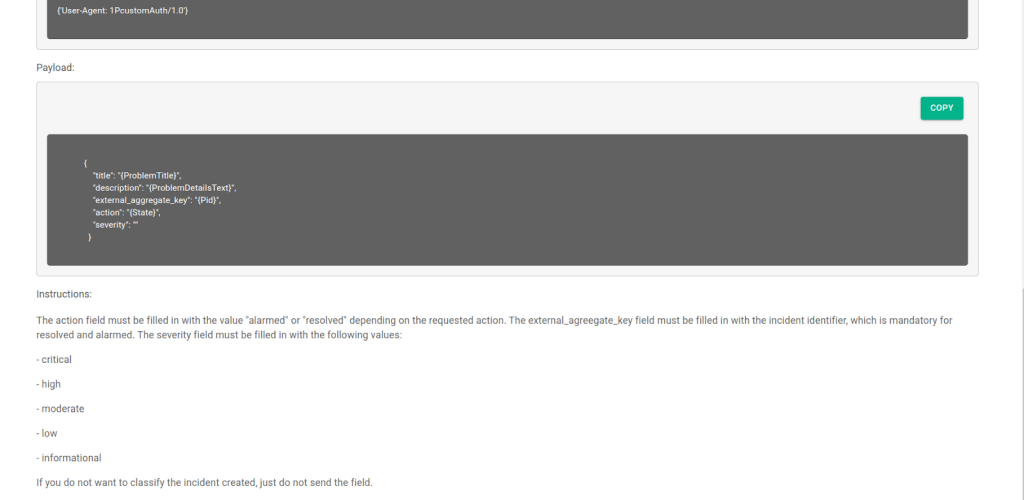
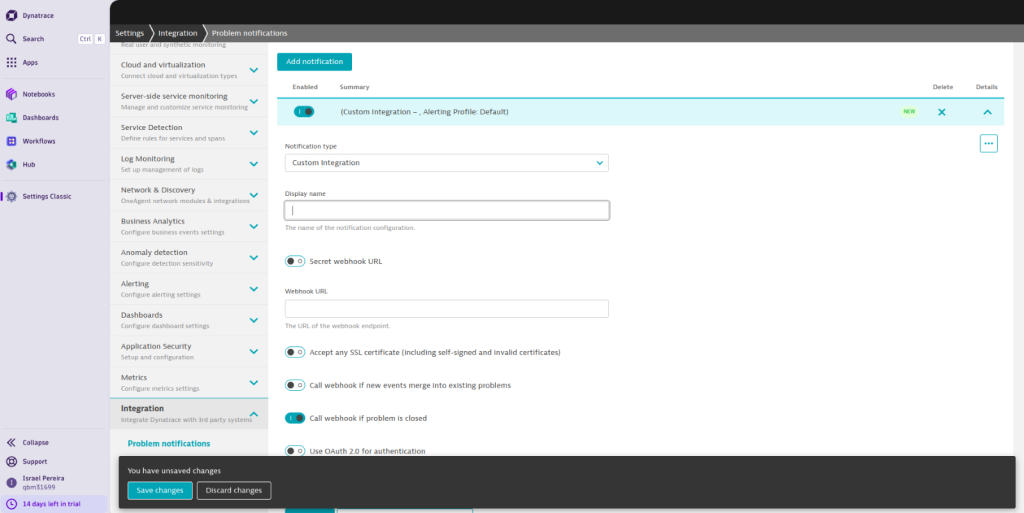
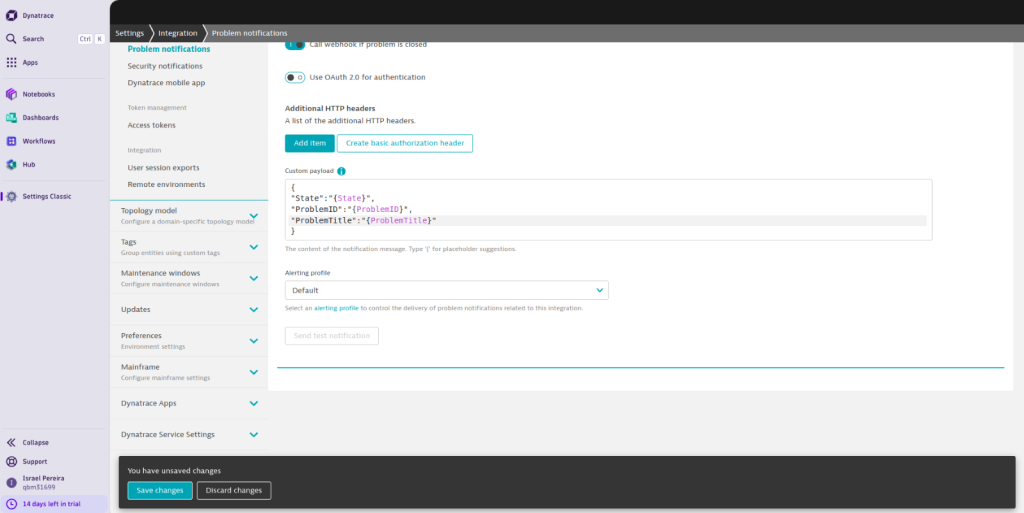
In the next step, click Add Notification to create your new notification. Choose the notification type as Custom Integration and enter a friendly name in the Display Name field to make it easier to identify. In the Webhook URL field, enter the URL you obtained when setting up the external service in External Service Dynatrace. Remember to enable the Call Webhook if problem is Closed option, ensuring you will be notified both when issues are opened and closed. Also, add an HTTP header by setting the name as User-Agent and the value as 1PCustomAuth/1.0. In the Custom Payload field, you must paste the content provided by the Elven Platform. This payload is essential for the integration and must include the severity levels, which range from critical to informational, including high, moderate, and low.
The severity field must be filled with the following values: critical, high, moderate, low, and informational.
critical
high
moderate
low
informational
Finally, select the Alerting Profile that corresponds to the types of incidents you want to monitor and click Save Changes.
Once configured, the service will appear in the External Services Monitoring Center, categorized by status, making it easier to monitor incidents, with priority given to those in an alarm state.
Additional Security and Performance Settings
IP Whitelist: API communication can be configured to allow only authorized IPs. To enable or modify this setting, contact Elven Platform support.
Rate Limiting: The default time for request limiting is 5 minutes, but it can be adjusted as needed. For changes, contact Elven Platform support.
These settings ensure greater security and control over the data traffic between the integrated systems.
Glossary of Technical Terms
API Token: A unique key generated to enable secure integration between platforms, ensuring authenticated information exchange. In Elven Platform, it is created in Organization Settings, under the API section. External Service Name: Name assigned to the external service during its configuration in Elven Platform, used for identification and organization. Responders: Individuals or teams designated as responsible for receiving notifications and acting on the resolution of incidents related to the integrated service. Webhook: A method for sending real-time notifications or events from one application to another. In Dynatrace, the webhook is configured with a Webhook URL provided by Elven Platform to ensure integration. Webhook URL: URL provided by Elven Platform used in Dynatrace to route notifications and events to the integrated platform. Custom Integration: Type of notification configured in Dynatrace to create a personalized integration, allowing specification of details such as payload and HTTP headers. Problem Notification: A Dynatrace feature that allows configuring notifications based on events or incidents monitored by the tool. Custom Payload: Content sent by Dynatrace via webhook that includes incident details, such as severity level. The payload format is defined by the Elven Platform team. Severity: Level of seriousness of the incident recorded in Dynatrace, classified as:
Critical: Critical issue requiring immediate attention.
High: High-priority issue.
Moderate: Moderate issue that may partially impact the system.
Low: Low-priority issue.
Informational: Information with no direct impact on the system.
Alerting Profile: Profile configured in Dynatrace to define which types of incidents or alerts should be monitored and notified.
User-Agent: HTTP header used to identify the client making a request to the API, configured as 1PCustomAuth/1.0 in the Dynatrace webhook.
Integration: Section in the Dynatrace settings menu where integrations such as Problem Notification can be managed.
Add Notification: Option in Dynatrace to create a new custom notification, used to configure event delivery to Elven Platform.
Last updated
Was this helpful?